
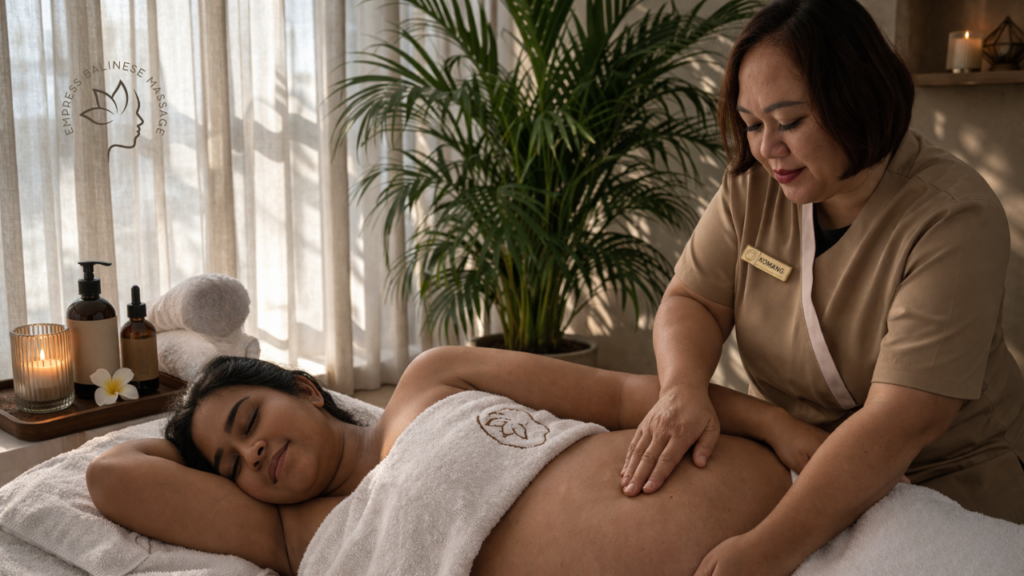
The place where pregnancy back pain is felt is not always the only area influencing it.
A client may point to her lower back, yet an experienced prenatal therapist may also notice that one hip rotates forward, one shoulder sits higher or more weight is being placed on one leg. Changes in posture, movement and the way the body is supported can all affect where discomfort is experienced.
During a pregnancy massage Dubai appointment, the therapist does not diagnose the source of pain. She observes how the client moves, asks careful questions and adapts the treatment around comfort.
Massage may support muscular relaxation, but persistent, severe or unusual back pain requires assessment from a maternity healthcare provider.
Why Is Back Pain Common During Pregnancy?
As pregnancy progresses, the body adapts to a growing abdomen and changing weight distribution. These changes can affect posture, the movement of the pelvic joints and the surrounding muscles. Back or pelvic discomfort may be felt in the lower back, hips, thighs, pubic area or middle back.
Some clients notice discomfort after standing for a long time. Others feel it when climbing stairs, turning in bed, getting out of a car or balancing on one leg while dressing.
The location and pattern may differ from one person to another. This is why a prenatal therapist should not immediately apply strong pressure to the exact point the client identifies.
The first step is understanding how the discomfort behaves.
The Painful Spot May Be Carrying Extra Work
During pregnancy, one part of the body may begin working harder to compensate for discomfort or changes elsewhere.
For example, a client who feels sensitive around one hip may unconsciously place more weight on the other leg. Someone protecting her lower back may use her shoulders and arms more when standing up or turning.
Over time, the area doing the extra work may begin to feel tired.
This does not mean the therapist can identify the medical cause of the pain. It means the massage may need to consider more than one isolated point.
Instead of repeatedly pressing the sore area, the therapist may work gently around connected muscles, improve the pillow support or adjust the client’s position.
What Does the Therapist Notice Before Treatment?
Observation begins before the client lies on the massage table.
The therapist may notice:
- How the client walks into the room
- Whether she takes shorter steps
- If more weight is placed on one side
- How she sits down and stands up
- Whether she protects her lower back
- If one shoulder appears higher
- How easily she turns
- Whether movement changes her breathing
These observations are combined with the client’s own description of what she feels.
A therapist should never announce a diagnosis based on posture or movement. Her role is to use these details to create a more comfortable massage and recognise when professional medical assessment may be more appropriate.
How the Hips and Pelvis May Influence Back Comfort
Discomfort described as back pain may sometimes be connected with how the client is moving through the hips and pelvis.
Pregnancy-related pelvic girdle pain, for example, may be felt in the lower back, hips, groin, thighs or pubic area. It can become more noticeable when walking, climbing stairs, standing on one leg or turning over in bed. A physiotherapist or maternity healthcare professional is responsible for assessing and diagnosing this condition.
During massage, the therapist may simply notice that:
- One hip feels less comfortable in side-lying
- The upper leg needs more support
- The client avoids turning towards one side
- One side of the lower back tightens more quickly
- The client feels pulling when the leg is not supported
Before increasing pressure, the therapist may reposition the pillows.
Sometimes improving support allows the surrounding muscles to settle more comfortably without using deeper massage.
How Shoulder Tension Can Be Connected
Pregnancy back discomfort is not always limited to the lower body.
A client may change how she sleeps, sits at a desk or uses her arms to help herself stand. These habits can leave the shoulders and upper back feeling tense.
The therapist may notice that the client:
- Rounds her shoulders while sitting
- Uses one arm more when standing
- Holds the shoulders close to the ears
- Tightens the upper body when turning
- Takes shallow breaths when lying down
Rather than treating the lower back alone, the therapist may create a more balanced session that also includes appropriate work around the upper back and shoulders.
Why Supported Side-Lying Matters
Empress performs prenatal massage predominantly in a supported side-lying position.
A Doomoo pregnancy pillow and additional pillows may be placed around the abdomen, back, head and legs. The aim is to prevent the client from holding herself in position.
If the upper leg is unsupported, the hip may rotate forward and the client may feel pulling through the pelvis or lower back. If the pillow beneath the head is too high, tension may develop through the neck and shoulders.
The therapist therefore checks the entire setup before focusing on the painful area.
Support may need to be changed several times during one session. What feels comfortable at the beginning may become less comfortable after the client has remained in the position for several minutes.
Why Strong Pressure Is Not Always the Answer
Clients experiencing back discomfort sometimes request the strongest available pressure because they want the therapist to “release the knot.”
During pregnancy, deeper pressure is not automatically more appropriate.
If the body is already guarding an area, pressing harder may cause the client to tighten further, hold her breath or move away from the therapist’s hands.
The therapist may instead:
- Begin with broad, gentle movements
- Work around the uncomfortable area
- Adjust the pillow support
- Use slower, controlled pressure
- Ask the client to describe the sensation
- Return to the area later
- Avoid the area if it remains sensitive the sensation
- Return to the area later
- Avoid the area if it remains sensitive
The effectiveness of a comfort-focused massage is not measured by how much pain the client tolerates.
Is Prenatal Massage the Same as Deep Tissue Massage?
No. Prenatal massage follows pregnancy-specific consultation, positioning and safety considerations.
A deep tissue massage Dubai treatment generally uses slower and more focused pressure around persistent muscular tension. During pregnancy, the therapist must be more selective about where focused pressure may be appropriate.
A prenatal client may enjoy controlled pressure around suitable areas such as the shoulders or upper back, but this does not mean a full deep tissue routine should be applied across the body.
The treatment remains prenatal massage because every decision is guided by pregnancy stage, comfort, positioning and suitability.
What Questions May the Therapist Ask?
Before working around pregnancy back discomfort, the therapist may ask:
- When did the discomfort begin?
- Is it constant or linked to movement?
- Does it affect one side or both?
- Does it become worse when walking or turning?
- Is there numbness, tingling or weakness?
- Has the pain been discussed with a doctor or midwife?
- Are there any other symptoms?
- Which positions feel comfortable?
- Does the pregnancy have any additional risks?
These questions do not replace a medical assessment.
They help the therapist recognise whether the session can proceed normally, requires adaptation or should be postponed.
When Back Pain Needs Medical Attention
Back pain should not automatically be treated as ordinary muscular tension.
Contact your maternity healthcare provider if back pain is accompanied by fever, burning during urination or vaginal bleeding, as these symptoms may require medical assessment. Back pain can sometimes be ason or pregnancy complication rather than muscular strain. citeturn459830search1
Severe abdominal or back pain also requires urgent medical guidance. New numbness around the inner thighs or buttocks, difficulty controllil, or significant leg weakness should be assessed urgently.
A painful, red, hot or unusually swollen leg may be a sign of a blood clot. Sudden brest pain or coughing blood requires immediate medical help. citeturn266073view3
Massage should be postponed when symptoms suggest that medical assessment is the safer next step.
How Empress Approaches Pregnancy Back Discomfort
Empress accepts prenatal massage bookings from 20 weeks onward.
Before treatment, the therapist discusses the client’s pregnancy stage, symptoms, pressure preferences and any advice provided by her maternity healthcare professional.
The therapist then observes how the client moves and prepares the side-lying position around her body.
During treatment, she may:
- Change the pressure by body area
- Add more support beneath the upper leg
- Adjust the pillow behind the back
- Spend more time around the shoulders or hips
- Work around rather than directly over a sensitive point
- Help the client turn slowly
- Shorten the time spent in one position
- Stop if unusual symptoms appear
The therapist does not claim to correct posture, realign the pelvis or treat a medical condition.
The purpose of the massage is to provide a calm, personalised wellness experience that may support muscular comfort and relaxation.
Why Home Massage Can Feel More Comfortable
A home appointment removes the need to travel through Dubai traffic or manage parking while already feeling physically uncomfortable.
The Empress therapist arrives approximately 10 to 15 minutes early with a professional massage table, clean towels, freshly laundered linens, suitable massage oil, a Doomoo pregnancy pillow and additional support equipment.
The client can choose a quiet area of her home, move at her own pace and continue resting after the treatment.
For someone experiencing pregnancy back discomfort, avoiding an immediate journey home can be an important part of the experience.
Frequently Asked Questions
Why can pregnancy back pain be felt in different areas?
Pregnancy-related changes can affect posture, weight distribution, pelvic movement and the surrounding muscles. Discomfort may therefore be felt in the lower back, hips, thighs or other connected areas. A therapist can observe movement patterns but cannot diagnose the medical cause of the pain.
Can massage identify the source of my back pain?
No. A prenatal therapist does not diagnose the source of back pain. She may notice posture, movement, muscle guarding and areas requiring support, then use those observations to personalise the massage. Persistent or severe pain should be assessed by a doctor, midwife or appropriately qualified physiotherapist.
Should the therapist massage directly over the painful spot?
Not always. Direct pressure may feel uncomfortable or cause the muscles to tighten further. The therapist may begin around the area, improve pillow support or address nearby muscular tension before deciding whether gentle focused work feels appropriate.
Can I request deep tissue pressure for pregnancy back pain?
You can discuss your pressure preference, but a prenatal massage should not become a full deep tissue treatment. Focused pressure may be used in suitable areas where appropriate, but pregnancy-specific safety, positioning and comfort remain the priority.
What position is used for pregnancy massage?
Empress predominantly uses supported side-lying positioning. A pregnancy pillow and additional support pillows may be placed around the abdomen, back, head and legs. The arrangement is adjusted according to the client’s pregnancy stage and comfort.
When should I avoid massage for back pain?
Postpone massage and seek medical guidance if the pain is severe, sudden or accompanied by bleeding, fever, painful urination, contractions, fluid leakage, numbness, weakness or bladder and bowel changes. A painful, red or unusually swollen leg also requires urgent assessment.
Can massage treat pelvic girdle pain?
Massage should not be presented as a treatment or cure for pelvic girdle pain. A maternity healthcare provider or physiotherapist should assess the condition. Massage may sometimes be included as a comfort-focused wellness service when approved and appropriately adapted.
Does Empress offer pregnancy massage before 20 weeks?
No. Empress accepts prenatal massage bookings from 20 weeks onward. Every appointment begins with a consultation and is adapted according to the client’s pregnancy stage, symptoms and comfort.
Book a Pregnancy Massage Shaped Around Your Comfort
From 20 weeks onward, Empress offers personalised pregnancy massage in your Dubai home or hotel.
Rather than repeatedly pressing the area that hurts, the therapist observes how you move, checks your support and adapts the pressure across suitable areas of the body.
Speak with the Empress team before booking if your back pain is new, severe, persistent or accompanied by other symptoms that may require guidance from your maternity healthcare provider.
